Is SIP Better Than FD for Long-Term Wealth Building?
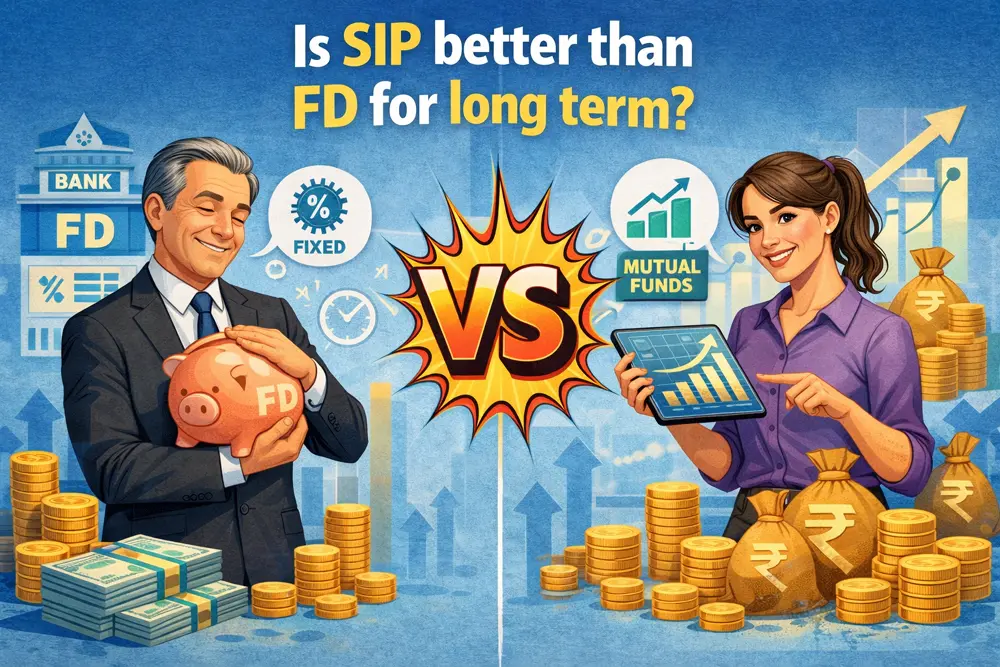
If you are trying to plan for long-term goals like retirement, children’s education, or financial security, the question of SIP versus FD often creates confusion. Fixed Deposits feel safe and familiar, while SIPs feel uncertain and market-linked. Many people hesitate because they do not want to make mistakes with hard-earned money. Others feel pressured by opinions from friends, relatives, or bank advisors. The truth is, both SIP and FD serve different purposes, and choosing between them depends on how long you are investing, your comfort with ups and downs, and what you expect your money to do over time. Understanding the real difference between SIP and FD can help you make a calm, informed decision instead of one based on fear or habit.
Who This Article Is For
This article is for people who want clarity before committing their savings for the long term. It is especially useful if you are confused about whether SIP or FD is better for goals that are 5, 10, or 20 years away.
It is also for those who currently rely only on Fixed Deposits and wonder if SIP could help their money grow faster. If you want to understand risk, returns, and real value without complicated jargon, this article is meant for you.
Quick Summary
For long-term investment, SIP generally performs better than FD because it has the potential to beat inflation and grow wealth over time. FD offers stability and guaranteed returns but usually struggles to maintain real purchasing power in the long run. SIP involves market risk but benefits from compounding and time.
Why This Problem Happens
This confusion exists because SIP and FD are often compared as if they serve the same purpose. In reality, they are built on completely different principles.
FD is designed for safety and predictability. SIP is designed for growth and long-term wealth creation. When people compare only short-term comfort instead of long-term outcomes, the decision becomes unclear.
Another reason is fear of market fluctuations. Many people remember short-term market drops but ignore long-term growth trends. This emotional bias makes FD feel safer, even when it may not be sufficient for future needs.
Detailed Explanation
To understand which option is better, you need to look at key differences clearly.
- Return potential
FDs offer fixed returns, usually moderate. SIP returns vary but historically have been higher over long periods. - Impact of inflation
FD returns often barely match inflation, reducing real value. SIP investments have the potential to grow faster than inflation. - Risk factor
FD carries minimal risk. SIP carries market risk but spreads it over time through regular investing. - Compounding effect
SIP benefits strongly from compounding over long durations. FD compounding is limited by lower rates. - Liquidity and flexibility
SIP allows flexible investment amounts and withdrawal options. FD may have penalties for early withdrawal.
An important insight many people miss is that risk is not only about market ups and downs. Risk also includes the risk of your money not growing enough to meet future expenses.
Real-Life / Practical Example
Imagine two individuals investing for 15 years.
Person A invests a fixed amount every month into an FD through recurring deposits, earning steady but modest returns.
Person B invests the same amount monthly through a SIP in a diversified fund.
After 15 years, Person A has certainty and stability, but the final amount struggles to match rising costs of education and living.
Person B experiences ups and downs during the journey but ends up with a significantly higher corpus due to long-term market growth and compounding.
This difference becomes more visible as the time period increases.
Clarification or Comparison
FD is best for capital protection, emergency funds, and short-term goals.
SIP is better suited for long-term goals where growth is essential.
FD gives peace of mind today. SIP builds purchasing power for tomorrow. Both have their place, but they are not interchangeable.
Why This Topic Confuses Most People
Many people are taught that safety means no risk. This makes FD feel like the obvious choice.
What is often ignored is that inflation silently erodes money. When returns do not outpace inflation, money loses value even if it feels safe.
Another reason is short-term thinking. People focus on yearly returns instead of long-term outcomes, which hides the true difference between SIP and FD.
Common Mistakes People Make
- Choosing FD only because it feels safe
- Avoiding SIP due to short-term market fear
- Ignoring inflation while planning long-term goals
- Stopping SIP during market downturns
- Comparing one-year SIP returns with FD returns
These mistakes usually come from emotional decisions rather than understanding how money grows over time.
Important Things Most People Ignore
One major factor people ignore is time. The longer you stay invested, the more SIP benefits from market cycles.
Another overlooked aspect is discipline. SIP enforces regular investing, which helps avoid emotional timing mistakes.
People also ignore the fact that FD interest is often taxed, which reduces effective returns, while long-term SIP gains may be more tax-efficient depending on holding period.
Frequently Asked Questions
Is SIP risky for long-term investment?
SIP involves market risk, but long-term investing reduces the impact of short-term volatility.
Can FD beat SIP in long term?
In most cases, FD struggles to beat SIP over long periods due to lower returns.
Is SIP suitable for conservative investors?
Yes, especially when chosen carefully and held for long durations.
Should I stop FD and move everything to SIP?
No. Both serve different purposes and can coexist in a balanced plan.
How long is considered long-term for SIP?
Generally, periods of 7 years or more are considered long-term for SIP investments.
What You Should Do Next
Start by identifying your goals and time horizon. Short-term needs may require safety, while long-term goals need growth.
Consider using FD for stability and emergency funds, while using SIP for long-term wealth creation.
Most importantly, stay consistent and patient. Time plays a bigger role than timing.
Final Thoughts
SIP is generally better than FD for long-term investment because it helps money grow in real terms. FD provides comfort and certainty, but SIP provides opportunity and growth. Understanding their roles allows you to use both wisely instead of choosing one blindly. Long-term financial peace comes from informed decisions, not fear-based ones.
Last updated: February 2026